Waterproof bathroom vanity Dubai: how they are built
A bathroom vanity survives in the UAE because of its carcass and its edges, not its door finish. Waterproof in practice means sealed cut edges, a protected back panel and a top that sends water away from the cabinet. Below is where cheap units fail, how the good ones are detailed, and what to check on a quote before you pay a deposit.
Why UAE bathrooms destroy ordinary vanities
Humidity does not stay in the shower tray here. It fills the room, and air conditioning pulls that moisture onto the coolest surfaces. The back of a vanity is usually the least ventilated panel in the bathroom, which is why the dampest part of a failed cabinet is the side nobody sees.
Then add how the room is actually used. A wet room floor gets hosed. The basin runs five times before breakfast. Splash sits on the counter and drains down the front edge into the door gap. None of that is unusual, and none of it is covered by a finish warranty.
The failure has a pattern. The bottom rail swells, the door drops a couple of millimetres, the hinge screws lose their bite, and a musty smell appears under the sink. By the time the door is rehung, the board behind it has gone.
What waterproof actually means
The word gets used loosely. No timber-based cabinet is waterproof the way a glass screen is. What you can buy is a cabinet whose water-exposed parts are sealed, raised off the wet and detailed so water drains away instead of soaking in.
Four things decide that.
The body. The board has to be a grade that tolerates intermittent moisture. That is the starting point, not the finish line.
The edges. Every cut edge is raw, open board, and it drinks water faster than any factory face. Edges must be sealed, and the sealing method matters more than the label on the sheet.
The back panel. This is the panel sitting a few millimetres off the wall, in the dark, in the dampest air in the room. Thin hardboard backs are common and they are the first thing to go.
The joints. Where two panels meet, water finds a capillary gap. Glue line, sealant and assembly order decide whether that gap stays shut.
A moisture resistant label tells you about the sheet, not about the cabinet. A well sealed MR-MDF unit beats a badly detailed marine ply one. The detail is the product.
The three points where vanities actually fail
Cut edges and screw holes. Every fixing is a puncture in the face. If the hole is not sealed before the screw goes in, water travels down the thread into the core.
The back panel against the wall. It needs a small gap, a vapour check and a sealed bottom edge, so any water that reaches it runs down and out rather than sitting.
The sink cut-out under the top. The hole for the basin exposes raw board in the one place that gets wet every day. It has to be sealed before the basin is fixed, not after.
Our new bathroom vanity looks beautiful. The custom top fits perfectly. We hired Just Right for the job. The workers were careful and clean. Syed Amaan, 5 stars
Clean work around a fitted top is usually a sign the cut-out was sealed before the basin went down. The business holds a Google rating of 5 from 4 reviews.
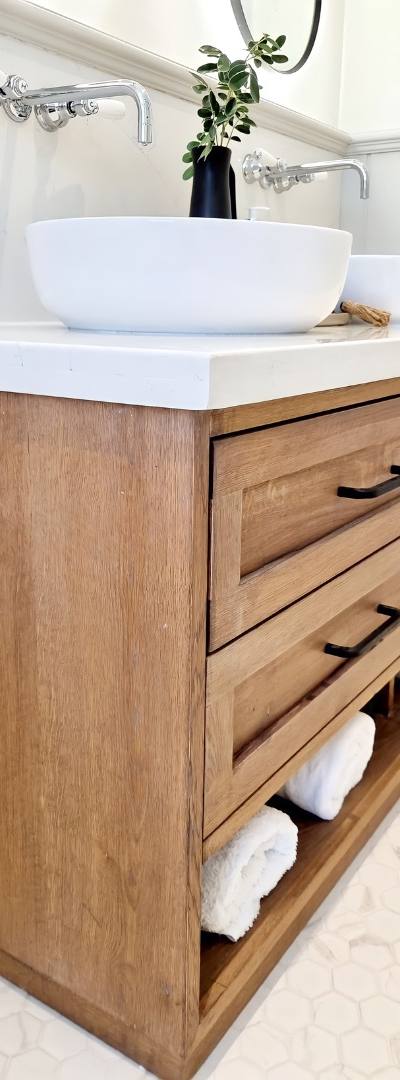
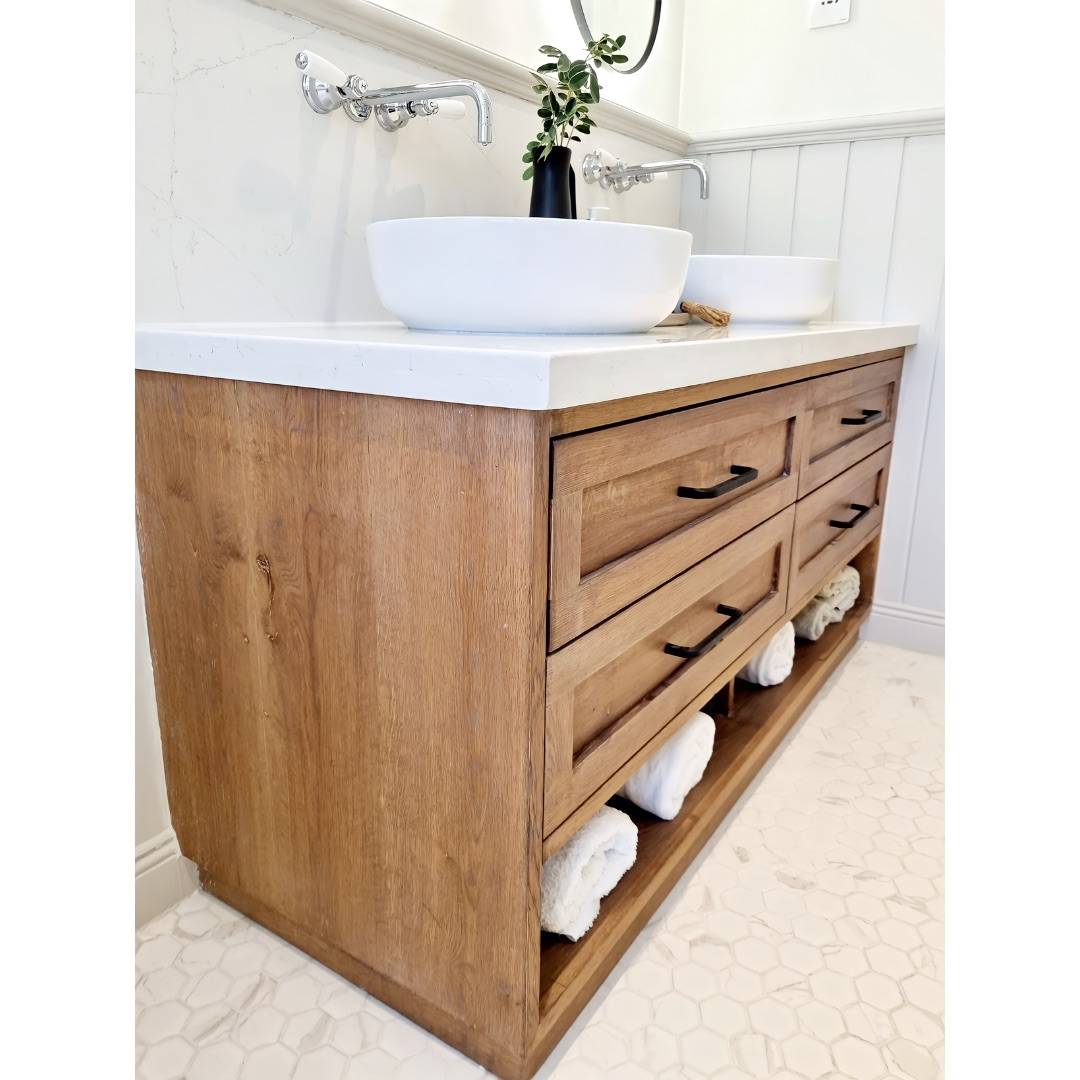 A double unit built to an approved drawing, with two vessel basins, a white top and matte black hardware.
Carcass materials compared honestly
| Carcass | Where it earns its place | Where it fails |
|---|---|---|
| Standard MDF | dry rooms, painted furniture | any floor-level bathroom unit, swelling starts at cut edges |
| MR-MDF | wall-hung units in a well-extracted bathroom | standing water at the base, unsealed sink cut-outs |
| Marine ply, WBP glue line | floor-standing units, wet rooms, sink cabinets | boards sold as marine with hidden voids and no WBP glue |
| Solid wood | frames and door stiles in dry zones | movement with humidity, joints opening over a season |
| PVC or compact HPL | full wet zones and commercial washrooms | fixing strength and cost per unit |
There is no single right answer, which is why the choice belongs on the drawing. A floor-standing unit in a wet room, a wall-hung unit over a tiled floor and a sink cabinet carrying a heavy stone top are three different specifications. We agree the carcass with you on paper, then build the vanity 1:1 to that approved drawing rather than to the nearest catalogue size. Finished vanity units from our Jebel Ali workshop show what that edge and joint work looks like up close, and the bathroom vanity materials Dubai: carcass and tops guide goes deeper on board grades if you want the longer version.
Floating or floor-standing in a wet zone, and the top detail
A wall-hung unit looks better and clears the floor for hosing. It also puts the whole load, stone top plus basin plus water, into the wall. That works on block or concrete. On a stud wall it only works if the framing was designed for the load before tiling went up. Hang a floating cabinet on plasterboard with cavity fixings and it will sag, and a sagging unit pulls the sealant line open at the top.
Floor-standing is more forgiving and easier to level on a wet room slope. Give it a sealed plinth or adjustable legs with a closed base, never bare board sitting on a wet floor.
The top needs a slight overhang past the carcass and a sealed joint where it meets the wall. An upstand protects that joint from splash and hides the sealant line. Sealant against tile is maintenance, not a permanent barrier: it needs replacing when it lifts, and the wall behind it has to be able to dry. Weight matters as well. A stone top with a vessel basin is heavy, so brackets, wall type and top thickness should be settled together on paper before the first fixing goes in. There are more bathroom vanity guides on the site if you are still choosing between layouts.
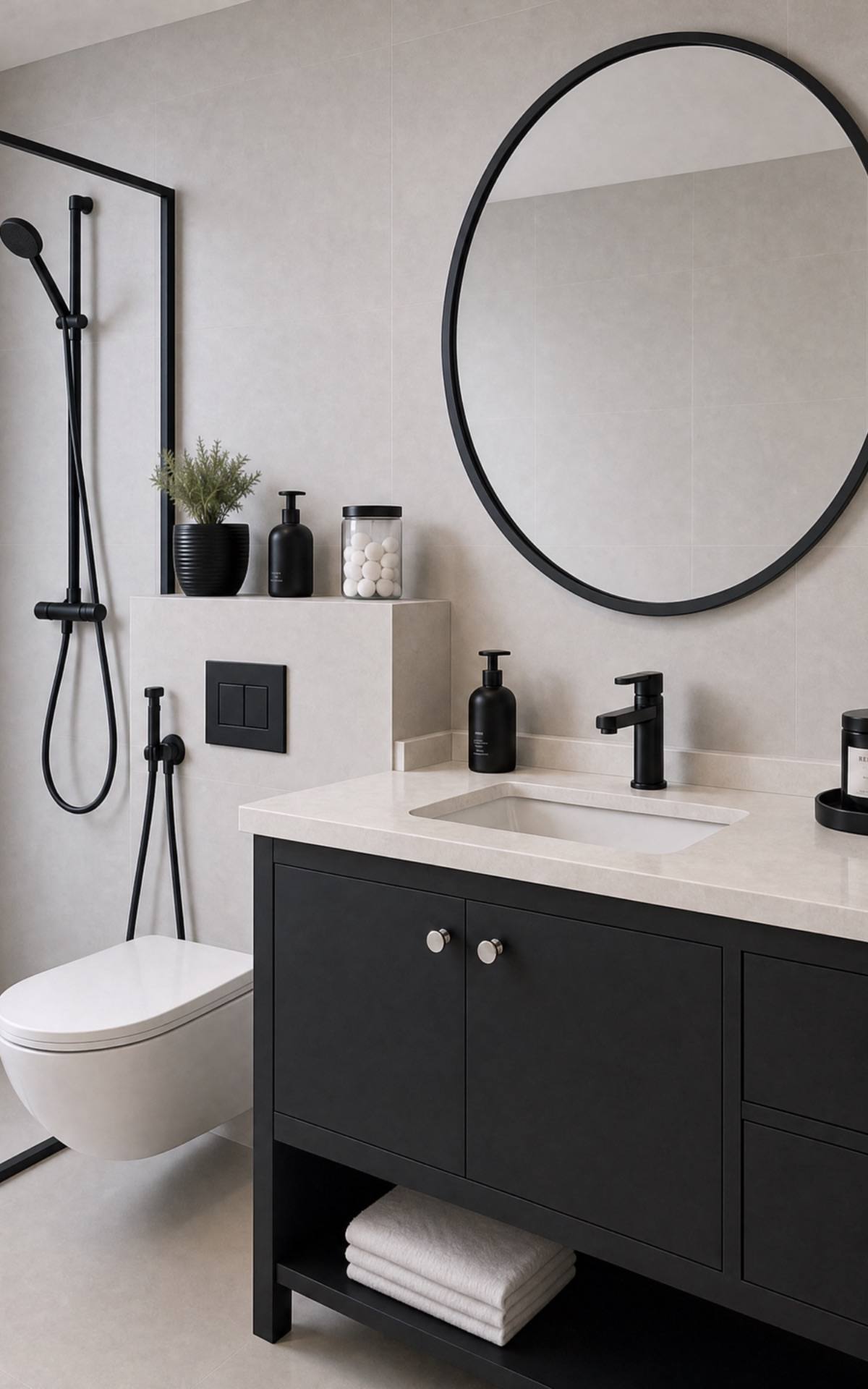
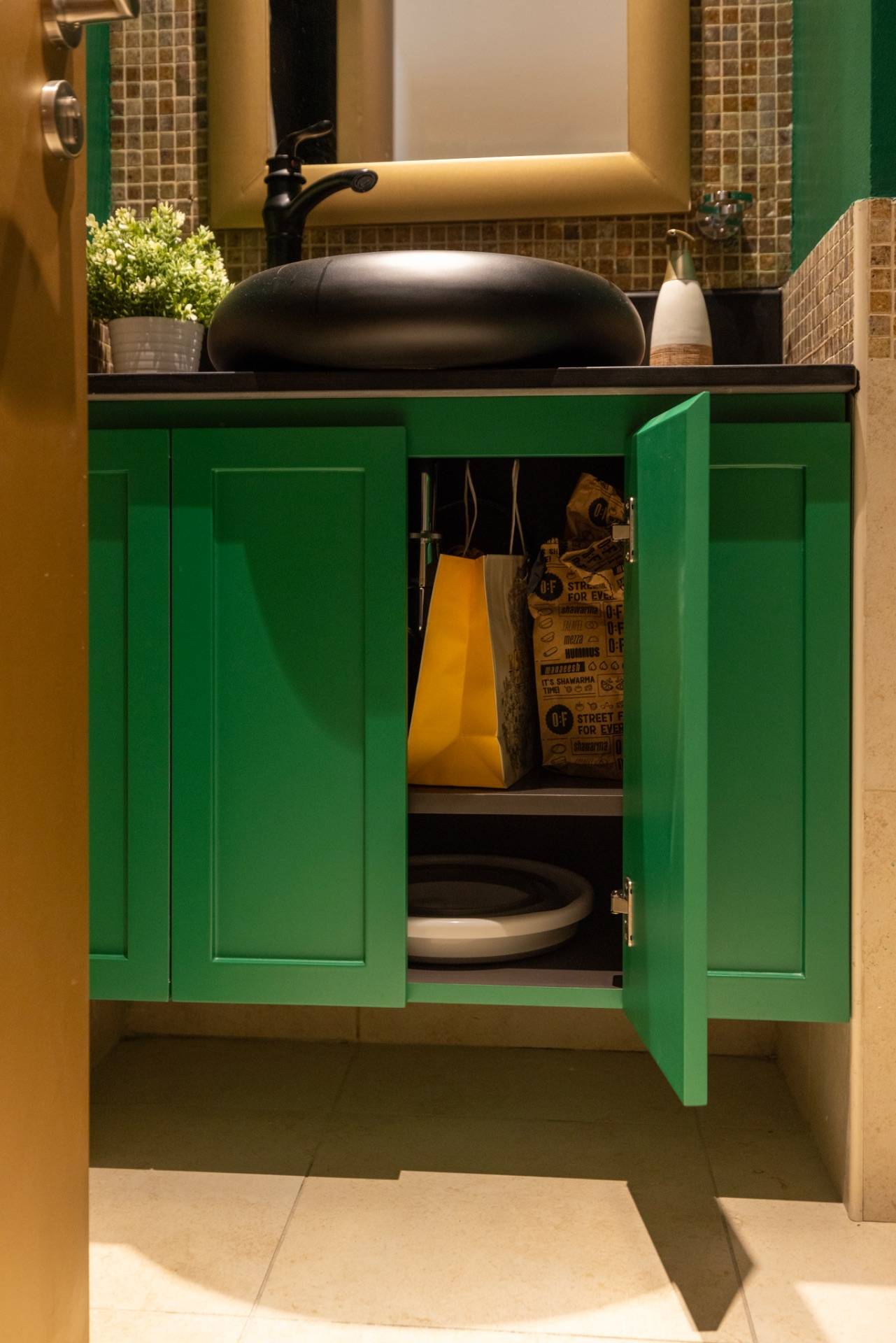 Shaker doors hide the carcass. Ask what is behind them: board grade, sealed edges and how the back panel is spaced off the wall.
What to ask before you pay
Five questions sort a good supplier from a fast one.
- How do you seal cut edges, and at which stage?
- What board grade goes into the body, the back panel and the shelf?
- Is the back panel spaced off the wall, and is its bottom edge sealed?
- Who fits the unit, and in what order relative to tanking and tiling?
- What is done at the sink cut-out before the basin goes on?
If the answer to the first question is that the board comes pre-finished, push. Every cabinet gets cut somewhere.
Then agree the sequence with the waterproofing and tiling trades. Tanking and tiling should be finished and cured before the vanity is set, so the unit is not moved twice and the sealant goes onto a clean, dry surface. Measure after tiling, never before: finished tile and adhesive change both the width and the depth you are working with, and a drawing that ignores tile thickness produces a cabinet that fits badly or not at all.
We build in our factory in Jebel Ali and install across all of the UAE. A made-to-measure unit with a stone top runs AED 6,000 to 8,000 all-in, at about 14 days from the drawing you approve.
For a quote on your own bathroom, send three things on WhatsApp: photos of the space including the wall the vanity will sit against, the finished width and depth measured after tiling, and where the waste and water pipes exit the wall. Add your location in the UAE and whether the wall is block, concrete or stud. You can also send your bathroom dimensions for a made-to-measure quote through the form, but WhatsApp is faster.
Frequently asked questions
Is marine ply better than MR-MDF for a bathroom vanity?
Neither is automatically better. Marine ply with a WBP glue line handles occasional water better at the core, but cheap boards sold as marine often have voids and glue lines you cannot see. A well sealed MR-MDF unit with sealed edges and a spaced back panel will outlast a badly detailed ply cabinet.
Do I need a floor-standing vanity in a wet room?
A wall-hung unit works in a wet room if the wall can carry it. Block or concrete is straightforward. Stud walls need framing designed for the load before tiling, because a stone top and a filled basin are heavy. On plasterboard with cavity fixings, choose floor-standing.
Can a stone top make a vanity leak proof?
No. The top sheds water, but the risk sits under it at the sink cut-out and at the joint against the wall. Ask how the cut-out is sealed before the basin goes in, and ask for an upstand so splash lands on tile rather than in the joint. Sealant is a maintenance item and needs replacing when it pulls away.
How long does a made-to-measure vanity take and what does it cost?
In our workshop a unit with a stone top runs AED 6,000 to 8,000 all-in and takes about 14 days from the drawing you approve. Size, carcass and top change the figure, which is why the drawing comes before the price. Every unit is built 1:1 to that approved drawing, so what you sign is what arrives.
Should I measure before or after tiling?
After. Finished tile and adhesive change both the width and the depth you have to work with, and the vanity has to sit against the finished surface. Measure the opening once tiling is complete, note where the waste and pipes exit the wall, and photograph the wall so fixing points can be checked.