Waterproof bathroom vanity Dubai: what survives humidity
A waterproof bathroom vanity in Dubai comes down to three things: the carcass board, how every edge is sealed, and how the unit meets the wall and floor. This guide covers what fails first in UAE bathrooms, which materials hold up, and what a made to measure unit costs.
Why work with Just Right Interior Decoration LLC
- Own factory in Jebel Ali, Dubai, with production and installation across all of the UAE
- Every vanity built 1:1 at full scale to the drawing you approve before cutting starts
- Fixed all-in pricing of AED 6,000 to AED 8,000 for a 1,200mm vanity with a stone top
- Around 14 days from approved drawing to installed unit
- Carcass choice in marine plywood, PVC foam board, WPC or solid wood frame
- Google rating of 5 from 3 reviews
Why bathrooms in the UAE destroy cheap vanities
Relative humidity in the UAE sits between 60 and 80 percent for much of the year, and most tower bathrooms have no openable window. Shower steam has nowhere to go, so it condenses on the coolest surfaces, and a vanity carcass is usually one of them.
The water sources that matter
- Airborne humidity, which finds every unsealed edge and cut out.
- Condensation on cold water pipes and the mixer body inside the cabinet.
- Direct steam and splash on the shower side panel, which is often the same panel as the vanity end.
Where it collects
Water pools at the bottom edge of the carcass, along the back panel touching the wall, and around the basin cut out in the top. Those are the three places a cheap unit fails, and all three are preventable.
What fails first on a standard vanity unit
Chipboard and MDF draw water through raw edges and swell from the inside. The swelling is permanent, and the board never returns to its original thickness.
The usual order of failure:
- Bottom edge swelling and blowing out by 3 to 8mm within two UAE summers
- Melamine or laminate peeling on the front edge where steam lands first
- Standard steel hinges and runners spotting rust at the screw holes
- Silicone behind the top turning black, because it was sealing damp board rather than dry board
- Back panel delaminating against a wall that stays cool and wet
Our new bathroom vanity looks beautiful. The custom top fits perfectly. We hired Just Right for the job. The workers were careful and clean. Syed Amaan, 5 stars
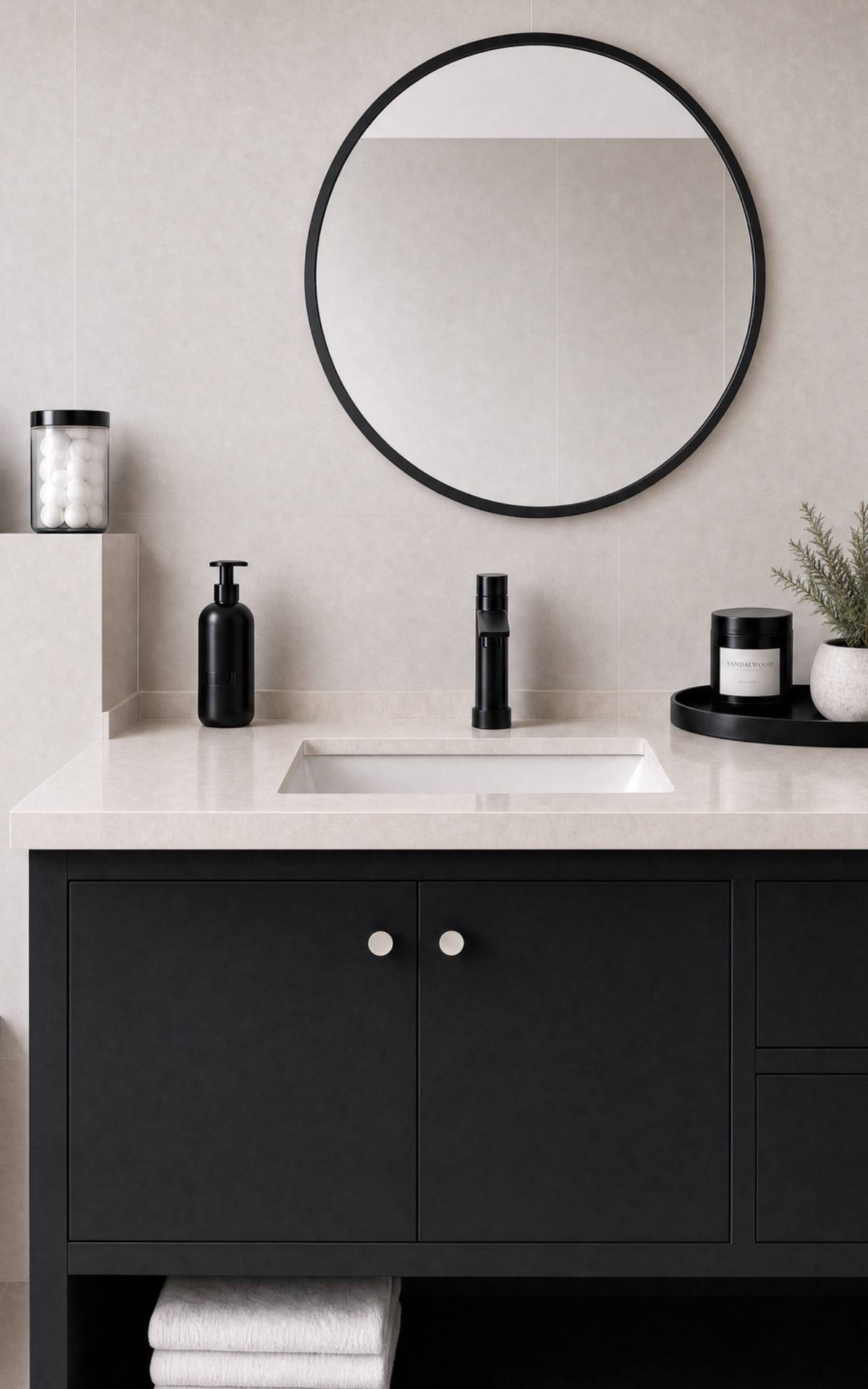
 A vanity built to the approved drawing, with the carcass set clear of the floor so spills dry out.
Carcass materials ranked for UAE humidity
Marine plywood is the sensible default for a UAE bathroom. PVC foam board is the fully waterproof option where the design allows it. Standard chipboard is not a bathroom material at 70 percent humidity, whatever the showroom label says.
| Carcass | Behaviour in UAE humidity | Weight | Cost versus chipboard | | Marine plywood, BS 1088 or WBP glue | Holds screws, resists swell, survives edge wetting if sealed | Medium | +40 to 60 percent | | PVC foam board | Waterproof through the full thickness, no swell | Light | +50 to 70 percent | | WPC board | Waterproof, dense, moderate screw hold | Heavy | +40 to 60 percent | | Solid wood frame with ply panels | Good if painted and sealed, moves with heat | Medium | +60 to 90 percent | | Standard chipboard or MDF | Swells, blows out, fails at edges | Light | Baseline |
Marine plywood with WBP glue
Ask for BS 1088 or, at minimum, WBP water and boil proof glue. It takes a hinge screwed and unscrewed several times, which matters when a door drops after two years. Compare the marine plywood and PVC carcass options before you commit.
PVC foam board
Waterproof all the way through, so a raw edge is less of a risk. It is lighter, which helps on a floating unit, but screws need pilot holes and load bearing points need inserts.
WPC and solid wood frames
WPC handles water well and feels solid in the hand. It is heavier on wall fixings. A solid wood frame with plywood panels works if every face is painted and sealed, and it suits a painted shaker door.
What not to buy
A chipboard carcass with a coated top is still a chipboard carcass. No top saves a board that is swelling from below.
Edge sealing and the stone top: details that matter more than the material name
A well sealed marine plywood box outlasts a badly sealed waterproof board every time. The board is only half the answer.
Specification to insist on:
- 2mm ABS banding on every visible edge, glued with PUR adhesive rather than ironed on
- Sealed PVC or sealed plywood for the back panel, never raw hardboard
- Basin and tap cut outs drilled, then sealed before the top is fitted
- A neutral cure silicone gasket along the wall and floor line, not just a bead across the front
- A quartz or stone top with a 100mm upstand to take splash before it reaches the carcass
The top and upstand are the water line
The top is the first line of defence and the upstand is the second. A full height stone upstand diverts far more splash than a shallow 100mm splashback, and it hides the wall junction where mould usually starts.
Sealant is maintenance, not a permanent fix
Neutral cure silicone in a wet area should be cut out and replaced every three to four years. Do that and the carcass behind it stays dry.
Siting and installation decisions that keep water out
How the unit meets the wall and floor causes as many failures as the board itself.
Legs versus floating
A floating vanity with a concealed frame looks better in a small bathroom. A leg standing unit is easier to inspect and dries underneath. Either works if the wall fixings are into masonry or a properly located stud, not into plasterboard alone.
Keep a moisture gap
Leave a 10 to 15mm gap between the back of the carcass and the wall, closed with a silicone gasket at the sides. Air moves, water does not sit.
Do not chase the wall
Cutting a channel into the wall for pipes breaches the tanking. Reroute the waste or adjust the carcass depth instead.
Put a fall on the top
A stone top should sit level or with a very slight fall away from the wall so splashes run to the front and onto the floor tile, not into the cabinet.
Ventilation is part of the installation
Bathroom extract in new UAE buildings is specified under Dubai Municipality and DEWA linked building rules, and it often runs below spec in older stock. If the extract is weak, run it during the shower and for 20 minutes after. A moisture resistant vanity carcass in the UAE buys time, but it is not a substitute for moving air.
For deeper comparisons across carcass types and costs, there are more bathroom vanity guides on the site.
What a made to measure waterproof vanity costs in the UAE
A 1,200mm marine plywood vanity with a quartz top, sealed edges, basin and installation lands at AED 6,000 to AED 8,000 all in. That price covers delivery and fitting anywhere in the UAE, including Sharjah and Abu Dhabi on the same 14 day cycle.
A typical split on that size:
- Marine plywood carcass, doors and sealed edges: around AED 3,400
- Quartz top with basin cut out and 100mm upstand: around AED 2,300
- Basin, tap, waste and installation labour: around AED 1,800
Upcharges worth knowing: a PVC or WPC carcass adds roughly AED 700 to AED 1,500 on the same footprint. A full height stone upstand in place of a 100mm splashback adds around AED 400 to AED 900. See the full AED 6,000-8,000 all-in vanity pricing page, including the free vanity offer on joinery packages over AED 50,000.
A very professional team, attentive to every detail. I commissioned a custom-made bathroom cabinet, and the final result exceeded my expectations. Diana Tosi, 5 stars
From measure to installation in about 14 days
- Free measure on site. Book a free measure in Dubai or anywhere in the UAE and the installer checks wall plumb, waste position, tile line and extract strength.
- Drawing issued for approval. Nothing is cut until you sign off the size, door style, top and upstand height.
- Factory build in Jebel Ali, 1:1 at full scale to the approved drawing. About 14 days.
- Delivery and installation. Carcass levelled, gasket run, top bedded, silicone finished.
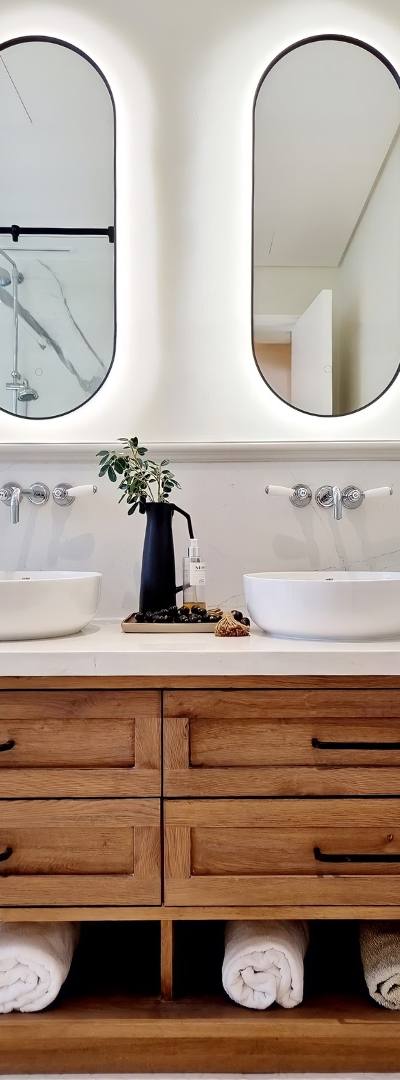
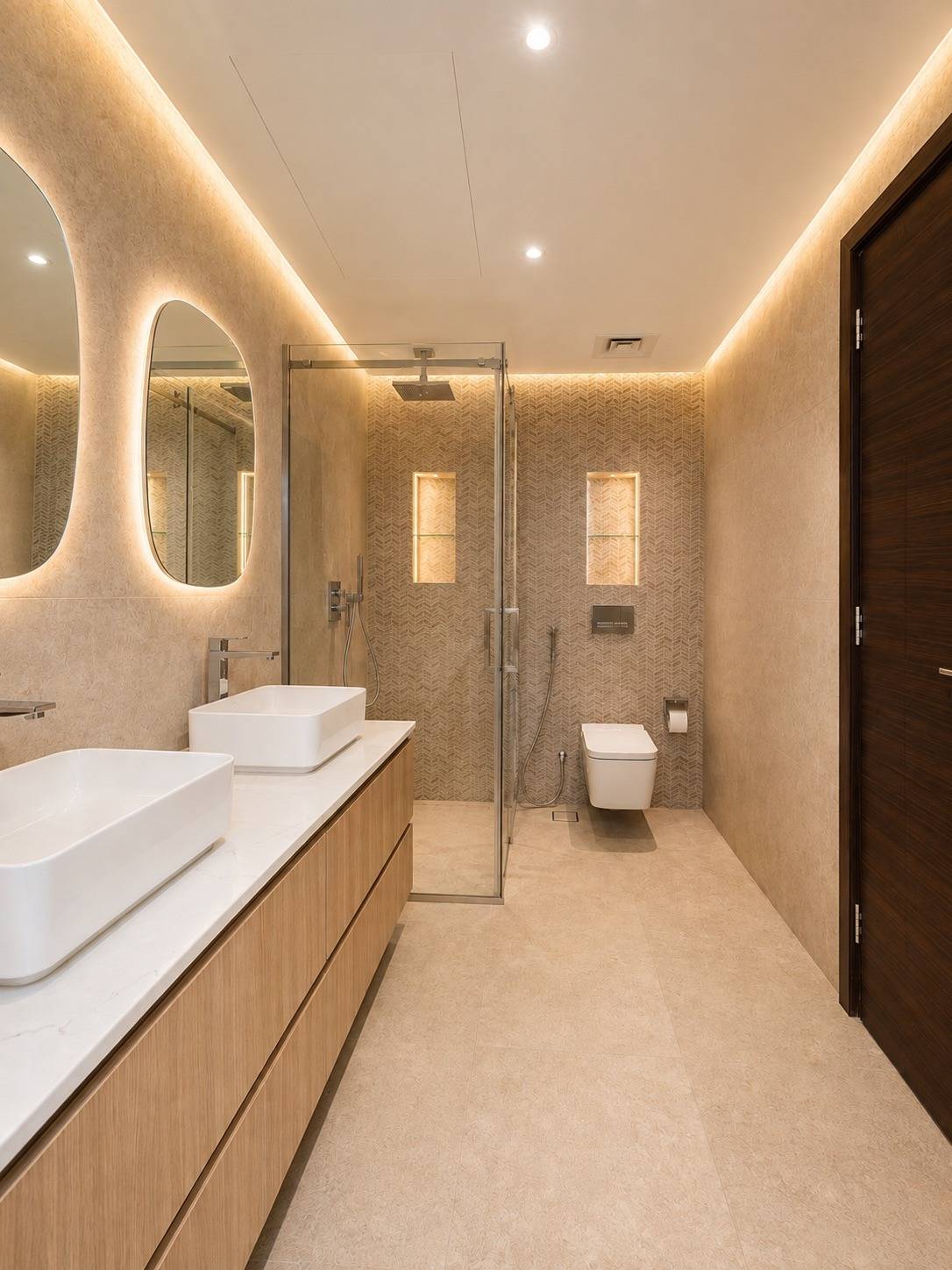 A double vanity built 1:1 to the approved drawing, with backlit mirrors and a sealed top to wall junction.
Frequently asked questions
How much does a waterproof bathroom vanity cost in Dubai?
Expect AED 6,000 to AED 8,000 all in for a 1,200mm made to measure unit with a marine plywood carcass, quartz top, basin and installation. PVC or WPC carcasses add roughly AED 700 to AED 1,500. Larger double units and full height stone upstands push the figure higher.
Is marine plywood better than PVC for a bathroom vanity in the UAE?
Marine plywood holds screws and hinges better over time and takes paint and veneer well. PVC foam board is fully waterproof through the board and is the safer choice for a unit that gets soaked regularly. Most UAE bathrooms are well served by sealed marine plywood.
How long does a custom vanity take to build and install?
Around 14 days from approved drawing to installed unit. Measuring and drawing approval usually takes two to four days before that. The clock starts when you sign the drawing, not when you enquire.
Can you build a vanity to fit an awkward tower bathroom?
Yes. Every unit is built 1:1 at full scale to the drawing you approve, so pipe boxing, off square walls and shallow depths are drawn first and cut once. That is the main reason made to measure beats a standard 600mm or 800mm cabinet in UAE apartments.
Do you install outside Dubai?
Yes. The factory is in Jebel Ali and installation covers all of the UAE, including Sharjah, Ajman, Abu Dhabi and Al Ain. Delivery and fitting are included in the quoted price, not added later.
Is a waterproof vanity fully waterproof?
No carcass is fully waterproof once it is drilled and hinged. The goal is water resistance plus sealed edges and a stone top that diverts splash. Check the sealant every few years and the unit will last.